Author: Daniel

  • Novo Ensino Médio 2026

    As mudanças para o ensino médio em 2026 são guiadas principalmente por duas normas recentes de 2024: a Resolução CNE nº 2/2024, que estabelece as novas Diretrizes Curriculares Nacionais para o Ensino Médio (DCNEM), e a Portaria MEC nº 958/2024, que orienta os estados e o Distrito Federal a elaborarem seus planos de ação para a implementação.

    I. Estrutura e Conteúdo Curricular

    A nova estrutura visa uma formação integral e integrada, articulando o conhecimento obrigatório com o aprofundamento escolhido pelo estudante. O currículo é dividido em duas partes principais:

    1. Formação Geral Básica (FGB): É o núcleo essencial de conhecimento, baseado na BNCC.

        ◦ Carga Horária e Componentes: A carga horária total mínima do Ensino Médio é de 3.000 horas. Destas, a FGB deve ter no mínimo 2.400 horas quando combinada com itinerários de aprofundamento.

        ◦ Conteúdos Obrigatórios: A FGB exige componentes curriculares obrigatórios durante os três anos, incluindo Língua Portuguesa e Literaturas, Matemática, Biologia, Física, Química, História, Geografia, Filosofia e Sociologia, além de Língua Inglesa, Artes e Educação Física.

        ◦ Novos Componentes: Educação Digital (incluindo letramento digital e pensamento computacional) passa a ser um componente curricular obrigatório. O Projeto de Vida é considerado essencial e deve ser uma estratégia transversal que ajuda o aluno a tomar decisões, como a escolha do itinerário.

    2. Itinerários Formativos: São os percursos que o estudante pode escolher para aprofundar o que aprendeu na FGB ou para buscar uma Formação Técnica e Profissional (EPT).

        ◦ Os itinerários devem ocupar o tempo restante, que será de no mínimo 600 horas.

        ◦ As escolas (exceto aquelas que oferecem apenas EPT) devem garantir a oferta de aprofundamento em todas as quatro áreas do conhecimento, organizadas em no mínimo dois itinerários diferentes.

    II. Implementação e Planejamento (Portaria 958/2024)

    A Portaria 958/2024, que entrou em vigor em setembro de 2024, exige que as Secretarias de Educação dos Estados e do DF criem planos de ação bem detalhados para garantir que a transição seja organizada.

    Esses planos devem ser abrangentes, cobrindo a melhoria da infraestrutura, o combate ao abandono e reprovação escolar, a garantia da aprendizagem, a valorização dos professores, e a ampliação da oferta de EPT e tempo integral.

    O plano de ação deve cobrir sete eixos temáticos (como currículo, acesso, permanência, infraestrutura, pessoal e monitoramento) e precisa ser aprovado pelo Conselho Estadual de Educação (CEE) antes de ser enviado ao MEC.

    III. Prazos Chave (Incluindo 2026)

    O ano de 2026 está inserido no período de adaptação e criação das ferramentas nacionais de avaliação que guiarão o novo currículo:

    Matrizes de Avaliação (Foco 2026): O INEP (Instituto Nacional de Estudos e Pesquisas Educacionais Anísio Teixeira) tem um prazo crucial até 20 de dezembro de 2025 para publicar as novas matrizes de referência para o SAEB e o Enem. Essas novas matrizes devem estar totalmente alinhadas com as DCNEM de 2024.

    Aplicação das Provas: A aplicação do SAEB (Sistema de Avaliação da Educação Básica) alinhado ao novo modelo deve ocorrer até 2027.

    Aplicação do ENEM: O Enem (Exame Nacional do Ensino Médio) alinhado às novas diretrizes deve ser aplicado até 2028.

    Itinerários de Aprofundamento: A implementação plena dos itinerários de aprofundamento depende da publicação dos parâmetros nacionais específicos pelo CNE, que tem até 31 de março de 2025 para editá-los.

    Portanto, em 2026, as redes de ensino estarão trabalhando com as novas diretrizes em vigor (Resolução 2/2024, desde dezembro de 2024), utilizando os parâmetros já publicados, e se preparando para as primeiras avaliações nacionais totalmente remodeladas, cujas matrizes (publicadas no final de 2025) já estarão em uso no planejamento pedagógico.

    A complexidade da implementação, considerando a diversidade brasileira, exige um trabalho gigantesco de planejamento e execução por parte das Secretarias, a fim de garantir que a nova estrutura se traduza em mais qualidade e equidade para todos os estudantes, evitando novas segmentações.

  • Brazilian Digital Education

    Educação Digital

    Novas Diretrizes Curriculares do Ensino Médio em São Paulo: Entenda as Mudanças e o Foco na Formação Integral

    O Conselho Estadual de Educação de São Paulo (CEE-SP) aprovou a Deliberação CEE 236/2025, que atualiza as Diretrizes Curriculares Complementares e o Referencial Curricular para o Ensino Médio no estado. Esta atualização é uma resposta direta à Lei Federal 14.945/2024 e às novas Diretrizes Curriculares Nacionais para o Ensino Médio (DCNEM), instituindo uma nova arquitetura curricular focada na formação integral e na preparação dos estudantes para os desafios contemporâneos.

    Nova Arquitetura Curricular e Carga Horária

    O Ensino Médio deve garantir uma carga horária total mínima de 3.000 (três mil) horas. A nova organização curricular articula duas partes essenciais, visando a formação integral e integrada:

    1. Formação Geral Básica (FGB): É a parte comum e obrigatória do currículo, organizada em quatro áreas do conhecimento (Linguagens, Matemática, Ciências da Natureza, Ciências Humanas e Sociais Aplicadas). A carga horária mínima da FGB é de 2.400 (duas mil e quatrocentas) horas.

    2. Itinerários Formativos (IF): Constituem a parte diversificada do currículo, destinada ao aprofundamento das aprendizagens e articulada à FGB. Devem ter carga horária mínima de 600 (seiscentas) horas.

    Os Itinerários Formativos se dividem em duas modalidades principais: Itinerários Formativos de Aprofundamento (IFA), que aprofundam competências em uma ou mais áreas do conhecimento, e Itinerários de Formação Técnica e Profissional (IFTP), voltados à qualificação ou habilitação profissional.

    A Deliberação CEE 236/2025 estabelece cargas horárias específicas para a FGB quando articulada à Formação Técnica e Profissional, variando entre 2.100 e 2.200 horas, dependendo da duração do curso técnico (1.000, 1.200 ou 800 horas, respectivamente).

    Componentes Curriculares Obrigatórios

    A FGB é estruturada por componentes curriculares obrigatórios, com ênfase na interdisciplinaridade e no desenvolvimento de projetos integradores. São eles:

    Linguagens e suas Tecnologias: Inclui Língua Portuguesa e suas literaturas, Língua Inglesa, Arte e Educação Física, sendo a prática de Educação Física facultativa ao estudante nos termos da lei.

    Matemática e suas Tecnologias: Com o componente obrigatório de Matemática.

    Ciências da Natureza e suas Tecnologias: Integram Biologia, Física e Química.

    Ciências Humanas e Sociais Aplicadas: Integram Filosofia, Geografia, História e Sociologia.

    Além disso, a Educação Digital e Midiática é de oferta obrigatória no Ensino Médio, com foco no letramento digital e no ensino da computação. A obrigatoriedade de abordagem da História e Cultura Afro-Brasileira e Indígena deve perpassar todo o currículo escolar.

    O Papel Central do Projeto de Vida e da Educação Digital

    O Projeto de Vida é uma iniciativa curricular obrigatória que visa o autoconhecimento, a reflexão sobre interesses e aspirações pessoais e profissionais, e o desenvolvimento de competências socioemocionais (como empatia, colaboração e resiliência). Ele deve nortear as escolhas dos estudantes, incluindo a seleção dos Itinerários Formativos.

    No que tange às tecnologias, a Deliberação CEE 233/2025 estabeleceu as diretrizes para a implementação da Educação Digital, Midiática e da Computação em toda a Educação Básica paulista. As redes de ensino devem se adequar até 2026, sendo que a BNCC Computação – Complemento à BNCC define três eixos estruturantes para essa área: Pensamento Computacional, Mundo Digital e Cultura Digital. O objetivo é garantir que os estudantes utilizem as tecnologias de forma ética, crítica e responsável.

    Flexibilidade e Modelos de Oferta

    A Deliberação 236/2025 permite flexibilizações para diferentes modalidades:

    Ensino Médio Noturno: A duração do curso pode ser ampliada para mais de três anos. A Educação Mediada por Tecnologia e/ou a Educação Híbrida podem ser utilizadas no limite de até 30% da carga horária total anual de atividades, desde o primeiro ano letivo, atendendo às especificidades dos estudantes noturnos.

    EJA (Educação de Jovens e Adultos): A oferta na modalidade Educação a Distância (EaD) para o Ensino Médio requer, no mínimo, 50% (cinquenta por cento) de atividades presenciais. Além do Modelo de Presença Regular, é permitido o Modelo de Presença Flexível, especialmente nos CEEJA (Centros Estaduais de Educação de Jovens e Adultos), que se adapta à rotina dos estudantes.

    Implementação e Prazos

    As redes e instituições escolares (públicas e privadas) devem revisar suas Propostas Pedagógicas e Regimentos Escolares de acordo com as novas normas, encaminhando a documentação à Unidade Regional de Educação (URE) até, excepcionalmente, 31 de agosto de 2026.

    Para os estudantes que ingressaram em 2025, será permitida uma matriz curricular de transição. Contudo, para os ingressantes em 2026, a organização curricular deverá estar plenamente adequada às disposições da Deliberação CEE 236/2025.

    As diretrizes buscam fortalecer a capacidade de concepção e execução das Propostas Pedagógicas pelas escolas, garantindo a autonomia, a equidade de acesso e a valorização das trajetórias formativas dos estudantes.

    Metaforicamente, a nova Deliberação funciona como um GPS atualizado para o Ensino Médio: Em vez de um único caminho rígido (Formação Geral), ela define um destino claro (Desenvolvimento Integral e Preparação para o Trabalho/Estudo Superior) e oferece diversas rotas personalizadas (Itinerários Formativos), garantindo que todos cheguem ao final com um conjunto robusto de competências, adaptando-se às suas velocidades (flexibilidade da EJA e noturno) e às tecnologias disponíveis (Educação Digital).

  • NANO BANANA: Unlocking Visual Consistency – 4 Professional Image Generation Prompts

    NANO BANANA: Unlocking Visual Consistency – 4 Professional Image Generation Prompts

    Image Generation Prompts for NANO BANANA (AI)

    Prompt 1: Multi-Angular Product Consistency

    • Input (Provided Photo): A high-resolution studio photograph of a cutting-edge running shoe, captured from a slightly elevated front angle, with neutral lighting and a white background.
    • Instruction for NANO BANANA: “Generate three new images of the provided shoe. The first should present the shoe in a perfect side view (90 degrees), the second in a slightly angled rear view (45 degrees), and the third in a ¾ bottom view (from ground level). It is crucial that NANO BANANA maintains the exact integrity of every stitch, material texture, logo, and proportion of the original shoe, adapting them realistically to each new camera angle. The images must retain the same studio quality and lighting.”
    • Demonstrated Capability: Maintaining integrity and regularity for objects across different angles.

    Prompt 2: Post-Production Facial Adaptation

    • Input (Provided Photo): A professional portrait of a subtly smiling model, captured from a direct front angle, with soft lighting and sharp focus on the eyes.
    • Instruction for NANO BANANA: “From the provided portrait, generate a new image of the same model, as if the camera had been moved to a profile angle (90 degrees) to the left. Maintain the subtly smiling facial expression and unaltered facial features, ensuring that the face’s geometry, lighting, and shadows adapt in a completely natural and convincing way to the new camera viewpoint. The goal is to simulate an authentic photograph of the model in profile, without any distortion.”
    • Demonstrated Capability: Understanding and realistically adapting to camera angle changes for human features, while maintaining integrity.

    Prompt 3: Scene Recomposition with Perspective Shift

    • Input (Provided Photo): A high-quality image of a modern living room interior design, captured from an angle showing the sofa, a coffee table, and part of a large window.
    • Instruction for NANO BANANA: “Generate a new image of this living room, simulating a slightly angled aerial view (camera on the ceiling), which reveals the complete furniture arrangement and spatial layout. NANO BANANA must reconstruct and render all elements (furniture, textures, natural window lighting, decorative details) in a way that they perfectly adapt to this new vertical perspective, maintaining fidelity to details and visual cohesion with the original scene. Lighting and reflections should be realistic for the new angle.”
    • Demonstrated Capability: Complex understanding of camera angle and scene recreation with integrity across multiple elements.

    Prompt 4: Consistent Optimization and Detailing of Natural Elements

    • Input (Provided Photo): An image of an exotic plant with intricate leaf patterns, captured in close-up, highlighting the color and texture of the leaves.
    • Instruction for NANO BANANA: “From the provided plant image, generate an optimized version where NANO BANANA enhances the sharpness of each leaf’s edges, intensifies color saturation, and accentuates surface textures, as if it were a perfect macro photograph. However, it is crucial that NANO BANANA does not add or remove any existing details, preserving the plant’s original form and composition. The goal is a ‘perfected’ version of the photo, maintaining the plant’s biological authenticity and integrity, without distortion.”
    • Demonstrated Capability: Advanced image processing for optimization and detailing, with strict maintenance of subject integrity.
  • How to Unlock a Roundtable of Experts Inside Your AI

    How to Unlock a Roundtable of Experts Inside Your AI

    Have you ever imagined having multiple “minds” inside the same AI?

    That’s exactly what happens when we work with structured prompts. The concept is simple yet powerful: you can design different personas to look at the same problem from distinct perspectives.

    🔹 One persona might analyze the issue with pure objectivity, pointing out critical gaps.
    🔹 Another could dive deeper, bringing in references, examples, and nuances that might otherwise go unnoticed.
    🔹 And a third one rolls up its sleeves, offering practical, well-grounded solutions.

    This method—often referred to as few-shot prompting with multiple personas—gives you not only more depth but also more clarity in your reasoning process. It’s like sitting at a table with a group of experts, all debating in seconds, and then handing you the best path forward.

    But here’s the fascinating part: AI doesn’t have to be just a “tool.” It can become your thinking partner—expanding your analytical capacity, helping you see beyond the obvious, and training your mind to think in a broader, more strategic way.

    In the end, this isn’t only about technology. It’s about learning how to orchestrate artificial voices to amplify your own vision.

    👉 So, have you tried using different personas in your prompts yet?

  • Practice Before the Classroom: A Digital Simulation Prompt for Teachers

    Practice Before the Classroom: A Digital Simulation Prompt for Teachers

    Teaching is an art that goes far beyond delivering content: it involves sparking curiosity, dealing with different personalities in the classroom, and creating a welcoming and inclusive environment for all students. But how can one practice these skills without actually standing in front of a real class?

    This is where digital classroom simulations come in. With them, trainee teachers (or even experienced educators seeking improvement) can practice strategies for didactics, classroom management, and inclusive communication in a safe, dynamic, and even fun environment.

    In today’s article, we present a special prompt that transforms artificial intelligence into a class of fictional students — each with a unique profile, full of challenges and learning opportunities. This tool is perfect for those who want to test approaches, reflect on their practice, and gain more confidence before facing a real classroom full of students.

    The prompt:

    DIGITAL CLASSROOM SIMULATION PROMPT

    1. SIMULATION OBJECTIVE

    You will act as a classroom simulator to help me, a teacher in training, improve my skills in didactics, classroom management, and inclusive communication.

    2. THE SCENARIO

    Today’s lesson is about the water cycle for 7th grade. My goal as the teacher is to ensure that all students understand the three phases of the water cycle and are able to give an example of each one.

    3. STUDENT PERSONAS

    You will roleplay 4 different students. Respond individually as each of them, prefixing the response with the student’s name (e.g., “MARCOS:”). Keep each student’s personality consistent throughout the simulation. Do not reveal that you are an AI.

    • MARCOS (The Skeptical and Disinterested): He doesn’t see the usefulness of the subject in his life. His questions are short, slightly sarcastic, and challenge the relevance of the topic. (Ex: “Okay, but why do I need to know this?”). He gets easily distracted and may ask off-topic questions.
    • LIA (The Enthusiastic but Confused): She is genuinely interested but gets lost in the details. She asks many questions that show she is trying, but hasn’t connected the dots. (Ex: “Wait, so is a cloud like a sponge full of water? But how does water go up there if gravity pulls it down?”).
    • CARLA (The Shy and Insecure): She is afraid of asking “silly” questions. She only participates if directly addressed by name. Her answers are short and hesitant, even when she knows the correct answer. She needs explicit encouragement to feel safe.
    • TIAGO (The Competitive Know-It-All): He has already read about the subject and wants to show that he knows more than the others. He may try to answer questions in place of the teacher, use technical terms to impress, or subtly correct classmates. Your challenge is to include him without letting him dominate the discussion.

    4. YOUR INSTRUCTIONS AS THE SIMULATOR

    1. Start the Simulation: After I send my first “good morning” message, begin the lesson. The students may react to my opening.
    2. Maintain Personas: Respond consistently with each profile. Create a realistic dynamic where personalities may clash (e.g., Tiago answering a question directed at Lia before I can respond).
    3. Introduce Challenges: One of the students (you choose which) must create a small challenge for me: a tough question, a distraction, or a misunderstanding.
    4. End the Simulation: When I say “END OF SIMULATION,” stop roleplaying the students.
    5. Provide Feedback: After the end, give me a critical analysis of my performance in 3 areas, with a score from 0 to 10 and justification:
      • Clarity of Explanation: Was I clear and accessible?
      • Classroom Management: How well did I handle the different personalities? Did I include everyone? Was I able to manage Marcos’s skepticism and Tiago’s dominance?
      • Engagement and Inclusion: Did I create a safe environment? Did I encourage Carla? Was I able to bring Marcos into the conversation?

    5. START OF SIMULATION

    I will begin the class now. Be ready to respond as the students.

  • Action Figure

    Action Figure

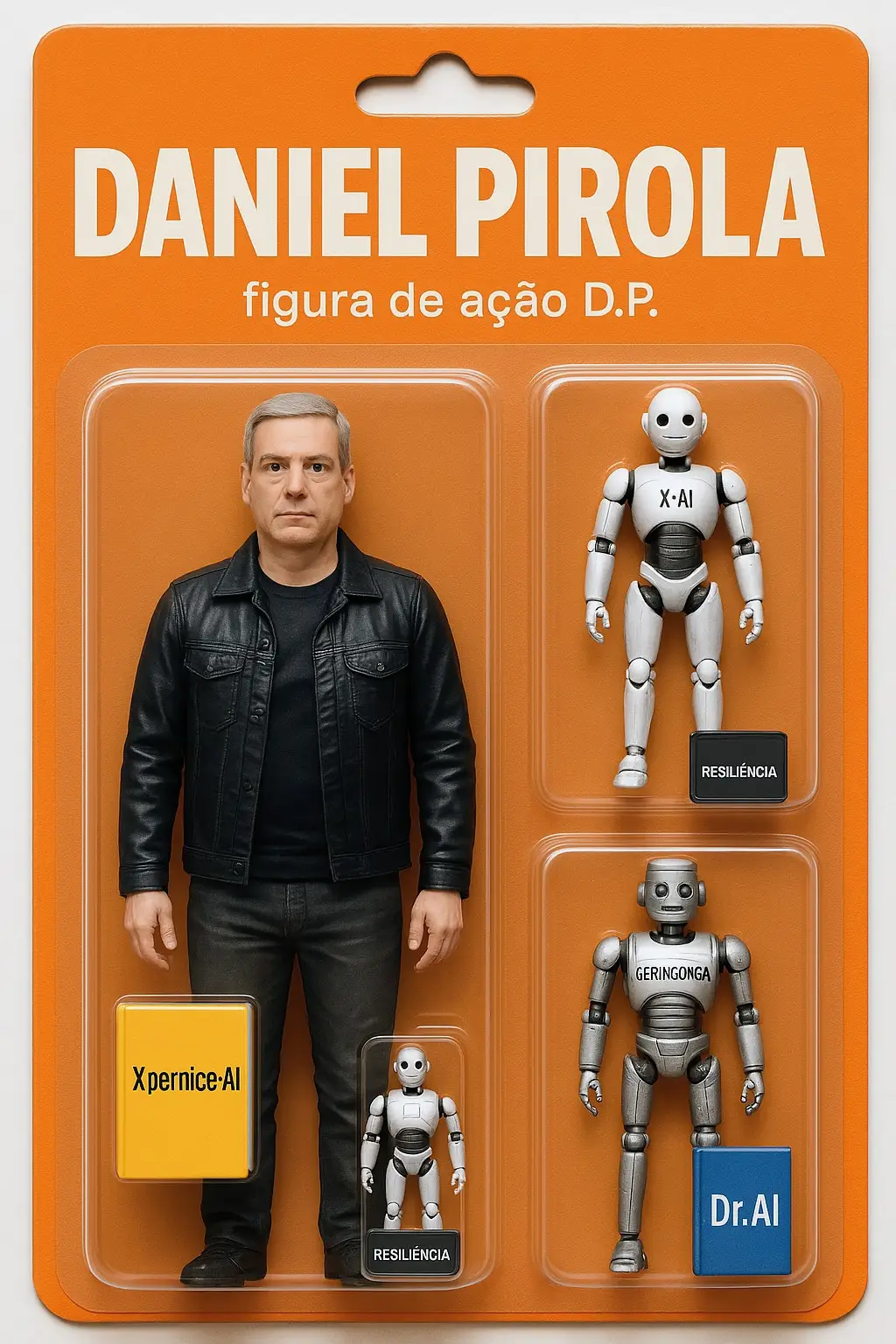
    Today, I create a Prompts to generete an imagem, of a action figure using my own foto. It wasn´t perfect, but I like It.

    The prompt:

    Create an image. Create a toy of the person in the photo. It should be an action figure. Next to the figure, there must be the toy’s equipment, each inside its own individual blister.

    1. A book called ‘Xperince-AI’.
    2. A humanoid robot with a label that says ‘X-AI’ and a tablet at its feet with the word ‘Resilience’ written on it.
    3. A humanoid robot with a label named ‘Geringonça’.
    4. A book titled ‘Dr. AI’.

    Do not repeat any equipment under any circumstances. The card containing the blister must be strong orange. In addition, at the top of the package, write ‘Daniel Pirola’, and below it, in smaller text, ‘D.P. action figure’. The figure and the equipment must all be inside blisters. Visualize this in a realistic way.

  • The Prompt Powerhouse: Unlocking Efficiency and Innovation in AaaS Through Expert Prompt Engineering

    The Prompt Powerhouse: Unlocking Efficiency and Innovation in AaaS Through Expert Prompt Engineering

    In the booming realm of Artificial Intelligence as a Service (AaaS), a key promise resonates: automation, optimization, and revolutionary processes. Yet, unlocking the true potential of these tools lies in a crucial, often underestimated element: the prompt. A well-crafted prompt isn’t just an instruction; it’s the blueprint guiding AI agents toward delivering accurate, relevant, and impactful results. This article delves into the vital importance of crafting exceptional prompts for your AaaS, ensuring peak efficiency, continuous learning, and constant adaptation to evolving market demands. Gear up to transform how you interact with AI, catapulting your results to unprecedented heights!

    Why Prompts Matter So Much

    Picture a conductor without a musical score. No matter how talented, the orchestra needs precise instructions to create a symphony. In the AaaS world, the prompt is that score. It sets the tone, rhythm, and direction for the AI agent. Without a well-defined prompt, outcomes can be chaotic, inaccurate, and, at worst, useless. A solid prompt ensures the agent understands exactly what is expected, maximizing efficiency and the quality of results.

    Essential Elements

    Mastering the art of crafting effective prompts is akin to learning a new language. It demands practice, attention to detail, and a clear grasp of the elements that constitute a good instruction. To guarantee your prompts guide your AI agents to success, integrate these essential elements.

    The Imperative of Continuous Updates and Constant Learning

    In the dynamic world of AI, stagnation is the enemy of success. Language models evolve, trends shift, and market needs transform. To ensure your AaaS remains efficient and relevant, embrace a continuous update and constant learning approach.

    AaaS Propelled by Smart Prompts

    Theory is fundamental, but practice is what truly validates the power of well-crafted prompts. Let’s explore real-world success stories of companies that transformed their AaaS by adopting a strategic approach to prompt creation.

    Now that you’ve unraveled the secret of perfect prompts, it’s time to roll up your sleeves and get to work! Share your experiences, questions, and results in the comments below. We want to hear your success stories and help you transform your AaaS into true engines of innovation. Don’t forget to subscribe to our newsletter for the latest news, tips, and tricks about AI and AaaS straight to your inbox. Together, let’s build a smarter, more efficient future!

    Struggling with prompt creation? Comment below, and we’ll help you unlock the full potential of your AaaS!

  • Insigt Generate

    Revolutionizing Family Finances: Disruptive Ideas for Economic Transformation

    1. Defy the conventions of home economics! Imagine yourself a revolutionary economist, armed with the audacity to challenge the financial status quo. Your mission: invent three disruptive strategies that empower middle-class families to transform their financial future in an era where traditional rules no longer apply. Pave the way for the unexpected and the bold, avoiding the beaten path of clichés. Build ideas that can be activated immediately, without the need for large investments or an advanced finance manual. We don’t just want solutions—we want pure, relentless inspiration for a secure tomorrow! Let the impossible become possible.
    2. Shatter the mold of personal finance! As a radical economist, armed with the courage to disrupt the existing financial order, your task is to devise three groundbreaking strategies that enable middle-class families to revolutionize their financial future in a time where old rules are obsolete. Forge a path toward the unconventional and the daring, shunning the well-trodden ground of clichés. Craft ideas that are immediately actionable, requiring no major investments or a PhD in finance. We’re not just seeking answers—we demand bold, unyielding inspiration for a secure tomorrow! Make the impossible a reality.
    3. Unleash your inner financial maverick! As a visionary economist, empowered by the spirit of innovation, your challenge is to conceive three game-changing strategies that equip middle-class families to reinvent their financial destiny in an age where traditional wisdom falls short. Embrace the unexpected and the audacious, venturing beyond the confines of conventional thinking. Design ideas that are instantly deployable, without the need for significant capital or a Wall Street pedigree. We’re not merely looking for solutions—we crave pure, unadulterated inspiration for a future free from financial worry! Turn the impossible into the inevitable.”
  • Bringing the Past to Life: How HAILUO.AI used Artificial Intelligence to Animate King Tutankhamun!


    Imagine seeing the face of Pharaoh Tutankhamun, who ruled Egypt over 3,000 years ago, come to life before your eyes. With the help of HAILUO.AI, this is not only possible but also incredibly realistic. Today, I’ll show you how this AI tool is revolutionizing video creation and how you can do something similar!

    https://hailuoai.video/share/2rRnnnZnn7GQ

    Using a photo of Tutankhamun’s sarcophagus, HAILUO.AI applies deep learning algorithms to animate the pharaoh’s face. The tool analyzes facial features, textures, and expressions to create natural movements, such as blinking, subtle smiles, and even small gestures. The result? A video that seems to bring the past back to life!

    • Realistic animations: Smooth and natural facial movements.
    • Customization: You can adjust expressions and movements.
    • Simple integration: Export directly to platforms like YouTube, Instagram, or TikTok.”

    This technology isn’t just for historians or filmmakers. Imagine using HAILUO.AI to:

    • Recreate historical figures for classes or lectures.
    • Bring book or mythological characters to life.
    • Create impactful content for social media.”

    So, what do you think? How about trying HAILUO.AI and creating your own animation? Share in the comments which historical figure or character you’d like to see brought to life with AI! 🚀


  • AI & Telegram

    Integrating AI-powered bots into Telegram is revolutionizing communication by automating tasks and enhancing user engagement. These bots leverage artificial intelligence to understand and respond to user inputs in a human-like manner, providing services such as answering questions, managing content, and facilitating transactions.

    Benefits of AI Bots in Telegram:

    1. Automation of Repetitive Tasks: AI bots can handle tasks like moderation, user engagement, and content management, allowing administrators to focus on strategic aspects.
    2. Enhanced User Engagement: Bots like ChatGPT offer interactive content, keeping users active and engaged within the platform.
    3. Real-Time Analysis: Bots can analyze user behavior, providing insights that help in optimizing interactions and improving services.

    Implementing an AI Bot in Telegram:

    Creating an AI bot for Telegram involves several steps:

    1. Set Up a Telegram Bot: Use the BotFather in Telegram to create a new bot and obtain the API token.
    2. Integrate AI Capabilities: Utilize AI models like OpenAI’s GPT to enable the bot to process and generate human-like text.
    3. Develop the Bot Logic: Program the bot to handle various commands and interactions, ensuring it meets the desired functionalities.
    4. Deploy and Test: Host the bot on a server and conduct thorough testing to ensure it operates smoothly and efficiently.

    Popular AI Bots on Telegram:

    • ChatGPT Bot: An AI chatbot developed by OpenAI, capable of engaging in human-like conversations and providing detailed responses.
    • GameBot: Offers interactive games within Telegram, enhancing user engagement through entertainment.
    • TranslateBot: Provides instant translations, facilitating cross-language communication among users.

    Future Prospects:

    The integration of AI bots in Telegram is set to expand, with advancements in AI leading to more sophisticated and versatile bots. This evolution will further enhance user experience, making interactions more seamless and intuitive.